
I keep buying a gallon of fat-free milk at my local store because it’s cheaper than the other sizes. The problem is, I am the only one who drinks fat-free milk in my house and I never seem to get to the whole gallon before it goes bad.
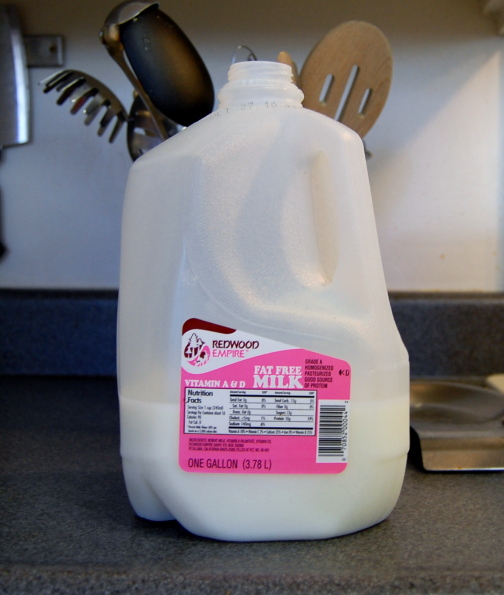
This time, instead of allowing this to happen, I made my own cottage cheese. It was insanely easy. Here’s how:
Cottage Cheese
(Note: Although I made this with one-third of a gallon of fat-free milk, I adjusted the recipe for a full gallon.)
Ingredients:
- 1 gallon fat-free milk
- .75 cup white vinegar
You’ll also need a:
- Pot
- Thermometer
- Cheesecloth or any other porous towel (good to have in a kitchen anyway)
- Colander
Directions:
Pour your milk into a pan
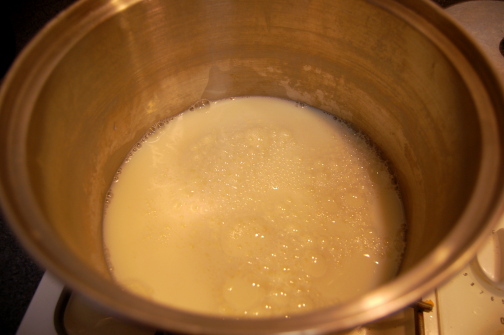
Using a thermometer, position it so that is it touching the milk but not the pan. Heat the milk up to 120 degrees.
When it reaches that temperature, turn off the heat. Add the vinegar. Let sit for a half hour.
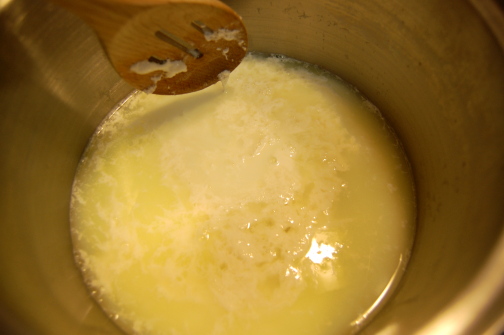
Now a weird thing happens. The milk curdles and separates into curds and whey, a greenish gross liquid. You might think you are doing it wrong, but no, that’s what’s supposed to happen.
Put a cheesecloth across a colander and dump the mixture out into it. Let the green stuff drain away for about 3 minutes. Wrap the cottage cheese in the cheesecloth and run under cool tap water for about 3 more minutes. While you do this, knead the cheese with your fingers.
Finally, pour the cheese into a bowl. You have just made cottage cheese.
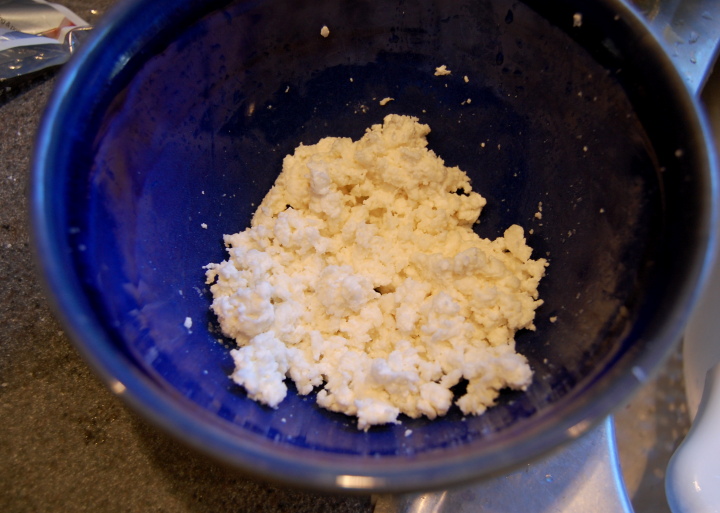
I made about a cup of cheese, so I’m guessing the above recipe makes about three cups. I ate it for breakfast this morning by mixing it with some honey, salt, and fresh figs. Let me tell you, it was awesome.
Another way to fix it is to mix it with some half-n-half and salt. Or you can use it to cook in lasagna or any other pasta dish that calls for ricotta.
Cost of Dish: Although I’m not convinced making cottage cheese saves you much compared to buying it in the store, it does save you money if you have extra skim milk around that would otherwise go bad. On top of that, homemade tastes better than store-bought, and that’s worth extra in my book.




Isn’t this Paneer? Or is it different somehow? At least packaged cottage cheese and paneer are really different, but I thought what you described is exactly how you make paneer.
Hi Katie – Thanks for commenting. This is a good question and had me wondering. I took a look and discovered that you’re right: This is paneer, but it’s also what is called dry curd cottage cheese or farmer’s cheese. It’s also similar to queso fresco in Mexico. Basically, it looks like several cultures make this kind of cheese and use it differently in dishes.
I guess traditional cottage cheese leaves some of the whey in, and often uses fermented milk (like buttermilk), which explains why cottage cheese has such a different texture when you buy it in the store. The recipe I was going by said to dump the whey and use half-n-half instead to make cottage cheese. Thanks again for pointing that out.
Found your site for the first time today and I’m enjoying catching up on your posts.
I’ve always loved cottage cheese and I was shocked to see that making it can it really be this easy. Thank you for posting this!
Dan
Casual Kitchen
Dan, welcome! I’m glad you are enjoying the site.
New reader here…had to laugh at your “greenish gross liquid”–took me back! That’s just about exactly what I thought the first time I made farmer’s cheese, but these days, I’m almost more interested in the whey than the curds. Ricotta, real ricotta, is made from the whey left over after making mozzarella (or other soft cheeses), and whey can be used for other things, too, pickles and soda and way beyond.
DSF
http://bokashislope.blogspot.com
DSF–That’s fascinating! It really is. I’ll have to take whey more seriously in the future.
Hi, great recipe. I’ve wanted to try making cottage cheese for so long.
couple of questions though, what’s “half-n-half”? Also silly question but 120 degrees is Fahrenheit right?
Thanks again!
Kathy–Half n Half is a mixture of half cream and half whole milk. If you don’t have that, whole milk would work fine. And yes the temperature is in Fahrenheit. Thanks for stopping by!
Thanks so much for this recipe. I love cottage cheese but I try to maintain a low salt diet and the store brands are so heavily salted that I became concerned. Now I can have my cottage cheese and less salt. I imagine that 1/2 or 3/4 of a teaspoon will be fine. I hardly ever use salt and I will do a taste test. Thanks!
Sandy, thanks for commenting. I’m glad the cottage cheese looks like it will be helpful to you. If you added something like honey to flavor the cheese, you could probably get away with avoiding salt altogether too.
Thanks for posting this! I love cottage cheese but it doesn’t exist in the country I’m living in now. Just a quick question – when you let the milk sit, do you leave it on the burner? If so, would it make a difference if you were using gas burners, which cool down much more quickly? Thanks again; I can’t wait to try this out!
Hey,
Great site. I was just wondering if anyone has tried making cottage cheese using lemon or lime juice?
Michelle, I somehow missed your comment before. My apologies. I turned off the heat and left the milk sitting on the burner. I don’t think gas or electric heat would matter unless your stove is extremely slow at cooling down.
Julie, funny you should ask that. I was just wondering about using lemon juice in cheese-making yesterday. I will look into it and get back to you.
Nutritionally, how does using vinegar differ from using rennet? Are the same enzymes produced?
Sey
Sey, you know, I think that is beyond my expertise. I can tell you that vinegar is 100% vegetarian, whereas with rennet that isn’t always the case, but I can’t tell you the difference, nutritionally speaking.
Thanks very much,I can’t buy cottage cheese in this part of France…Super!
I can’t wait to try this. quick question thou. I buy fresh cow’s milk and fresh goat milk. Will this work with the fresh milk from the start, or do I have to separate it first. Did you add the half and half after making the cottage from the skim milk?
pls.how much vinegar in litres per gallon
how much this degree in celesuse
how much this degree in celesuse
Hi, I liked the way you’ve explained and made it so clear!! I love cottage cheese and now that i know i’ll do my own. One silly question though what is a colander? And where can i buy it? Thanks
Hi folks, thanks for all your comments. To answer questions:
CK: As far as I know, this is just for skim milk, so you would probably have to separate the milk. You can add the half-and-half after you make the cheese if you want to.
Meleni: I’m not sure. You can look the conversion up on Google.
Yeni: A colander is a type of sieve: http://en.wikipedia.org/wiki/Colander
I started making home made cottage cheese 20 years ago when I lived in some less developed countries where cottage cheese was either not available or unreasonably priced (Sudan, Ghana, Senegal, Paraguay). In Ghana, for example, cottage cheese could be found, abut it cost about $5 USD per cup!
For my taste, vinegar yields a bit harsher taste, so I prefer lemon juice. Also, I learned that if you over heat the mix, it gets tough and the milk burns easily. I never was able to find rennet, but I mean to look into that process now that I’ve retired to the US.
I learned after many years of doing this that I should have been more careful about sterilizing the pans and implements; fortunately I never got sick, but it’s a good idea.
Finally, yes, this is really the same as paneer, but it tastes great and is perfect for lasagne.
– Anthony
Hi,pls.is it 0.75cub of vinegar(tea cub )or 0.75liters
Hi! I was searching for a cottage cheese recipe and came upon your site. I would also have asked what is half n half! I would like to try this now now and eat it for supper! Thanks for your site! And now I am going to search for mozarella! You people have inspired me!
Hello, I am living for the time being in Burundi (middle of Africa) where we also cannot get cottage cheese. My three year old daughter LOVES cottage cheese, but is very picky about the taste. For instance, she will eat only Trader Joe’s brand cottage cheese, not any other that I have found in the US. And, the taste of Trader Joe’s is definitely better — less sour.
That said, I attempted this recipe using citron juice instead (a kind of lemon). What I got were teeny curds, so that by the time I squeezed them in the cloth and rinsed them I just had a paste, no curds. Now that I look back at your recipe, I see that I should have let it stand for half an hour first; is that where I went wrong?
Also, the ‘paste’ has a very strong lemony flavor, which is lovely for me and my husband, but my daughter gagged and almost threw up. Does using vinegar impart less flavor than lemon juice?
Finally, I’m using UHT milk (ultra high heat pasteurized). It’s sterile, so can sit in a box unrefrigerated indefinitely. Anyone out there have any ideas how that’s affecting my result?
Thanks! Olivia
Hiya Olivia. Yeah, there’s a couple of issues there, the key one being that you have to let it sit for awhile to form curds. And yes, vinegar should be a less intrusive taste in the milk than lemon juice.
I have heard ultra pasteurized milk doesn’t work well for cheese making. I would say try it again with vinegar, any other kind of fat-free milk, and give it some time to form curds. Hope it works for you.
Thanks, Savvy. I did try again, still with the UHT milk but with vinegar this time, letting it sit for a while and it made no difference in the size of the curds, although the taste was better. Will try again tomorrow with fresher milk, and will let you know how it works out!
Olivia
Hi,
I use whey in my bread making. Gives the bread a tangy flavor, very good.
The cottage cheese recipe sounds great, will try it later today. I always make yogurt and also started making ricotta cheese.
Renate
Savvy,
My wife has Crohn’s and just started the specific carbohydrate diet. For this diet lactose is perhaps the worst carbohydrate for the patient. Most of the recipes call for dry curd cottage cheese (farmers cheese). We have had a hard time finding it. Milk on the other hand is universally available.
Thank you for the post.
Hi,
You can’t make decent cheese with Ultra-Pasteurized milk. The high heat of that type of pasteurization process denatures the protein in the milk and it will never form a proper curd.
However, if you can’t find good, fresh milk that is just regular pasteurized, you can substitute non fat dry milk and some cream (if you use the dry milk, it tastes best to add a little bit of cream to it). Just reconstitute the non-fat milk according to the package, and let it stay in the refrigerator overnight before you use it.
2 Tbsp of salt and 1 Tbsp of pepper for a perfect flavor.
Hi,
Cottage (and feta) cheese can be easily home-made with normal milk and some lemon juice or vinegar. Our grandmothers didn’t have or need thermometers and stainless steel !! It is like the oldest recipe in the world … BREAD, and yet many people think it is a mysterious process !
I add some coarse-ground pepper, or dried herbs (thyme, mint etc..), or garlic powder, or anything similar, with salt to taste.
Yoghurt making is just as simple, and much much cheaper than supermarket rates. From normal yoghurt (and with a simple cheesecloth) you can make “labneh” – thickened yoghurt – by draining excess water to any consistancy required !
Bon apetit …
When WWII started, I was 7. We moved from the center of Chicago to the boonies of the Arkansas Ozarks. We had 600 acres, pigs, horses, chickens, geese, cows. And milk. Lots of milk. Mom learned to be a farm wife and part of that was making cottage cheese from some of the milk. After it was made, some would be set aside to ripen into a soft, runny cheese much like the center of a good brie. We are of central/eastern European extraction and in Germany/Austria (my dad’s parentage)
this is called schmeer kease (say case) I am not sure of the spelling. I don’t know if the fact that we started with raw milk made any difference, but fresh or aged, it was delicious.
This is really informative.
I can now make fat free and salt free cottage for a friend on a very strict diet.
Thank you.
I just made this and it is kinda rubbery…is it supposed to be that way? did I squeeze it too dry?
I am loving all the great comments here! Glad you find the how-to useful.
Rochelle, I’m not sure. Either you squeezed too much or overcooked it.
I love it! It works really well as a sub for the Indian cheese, in the panier spinach dish!
I’m super excited to have found a cottage cheese recipe that doesn’t take 3 days! i cant wait to try it and all the extra comments have been extremely insiteful. One question though, i am pregnant and was under the impression that i shouldn’t eat soft cheeses, but i can eat store bought cottage cheese as far as i know, are there any differences with making it this way at home? i thought that since this recipe doesn’t sit out forever and i could quickly get it in the fridge soon after i make it that it wouldn’t be a problem but i’m not sure, what do you think?
Well Laci, congratulations! I am not a doctor, obviously, so you should ask them. I would assume the homemade stuff may not have the same pasteurization as store-bought cheese (extra bacteria that might harm the baby). However, since this recipe uses pasteurized milk, I would think it would be okay.
I never buy skim milk. O 2% either. Is it safe to think that if you can make this cottage cheese with 1/2-1/2, you could make it with whole milk? I would love to try it, but don’t want to waste the milk. Thanks.
Enjoyed reading all the comments, I now have my own home milk cow and she will be freshening soon. With regards to the vinegar–I noticed a comment that it was vegetarian–that is true ONLY if you know the source of your vinegar–Heinz recently ran a big ad asking if you knew where your vinegar came from: corn or petroleum? That’s right, vinegar as a by-product of oil is now being sold. Not on my table, for sure, and in fact, I make a point of getting organic vinegar and I actually like apple cider vinegar, it imparts a slightly different but lovely taste to your cottage cheese. Pour boiling water over your pot, colander and spoon to sterilize if you are pregnant or otherwise extra worried about sanitation, always a careful procedure and a good one. If you wash and re-use your cheesecloth or porous kitchen towel, be sure to include bleach in the wash water. Ultra-pastuerized milk or cream cannot form good curds because the milk protein has been too denatured. Overcooking results in tough curds and off flavor if you scorch. Watch that thermometer! You can make this type of cheese from other types of milk, and raw milk, rather than just skim. If you notice, the stores offer “regular” (which is usually 4% butterfat), “lowfat” from 2% milk and “nonfat” made from skim milk. Butterfat contains butyric acid, which is now known to be extremely healthy and good for our hearts, and I believe it is also our immune systems. “Funny fats”, the hydrogenated fats, which is what margarine is composed of, is responsible for the enormous increase in heart disease, arteriosclerosis and diabetes in this country (USA) especially, along with our insanely large amounts of sugar and white flour/products we eat. Make your own meals from scratch as much as possible and shop mostly around the perimeter of the usual type of grocery store (fresh produce, fresh dairy, fresh meat) and avoid prepared foods–they are toxic!
I have a question about cottage cheese, maybe someone can answer if for me. My wife and I decided to give cottage cheese a try a few months back and we both got a container (Wal-Mart brand) and it was delicious. We were hooked. It was cold and refreshing. I got the 4% small curd and she got the 4% large curd. So we enjoyed this for a few months until something changed and it stopped tasting good. We noticed at the time that the container switched from a plastic seal to a foil one. The curds were really small, more mushy and left a bitter after taste. We tried several containers, so we switched brands (Oak Farm)and it was delicious. Well now a couple months later the same thing has happened to that brand. We have tried several other brands and it is a hit or miss thing. Just to test things, my wife got a container of the Wal-Mart brand the other day and it was good again, so I am really confused!Does anyone know why the taste and texture changes?
If the foil has aluminum in it, it could contribute to an off flavor. Honestly, you would think these huge companies with all their research, etc. would KNOW this stuff! The plain plastic seal on most brands is actually more inert, taste-wise, because the acid from the small amount of remaining whey/buttermilk in your cottage cheese can and will react to a foil seal. Especially, if like many folks, you store your unopened tub of cheese upside down–for some reason that seems to increase its shelf life. Otherwise, it might just be that the commercial buttermilk starter/rennet/wheys have been permitted to get a touch ‘elderly’ before being replaced with fresh–the economy is bad, I suppose even big companies are cutting corners wherever they can. I’ve started making my own because it doesn’t have all the “extras” (including really large amounts of salt!) that commercial cottage cheese laces most of their brands with. A long time ago, a comment requested both the temperature in Celsius (which is 49 degrees Celsius for 120 degrees Farenheit) and how much 3/4 cup was in Litres. I looked it up, One ounce is .0295 Litres, so 3/4 cup at 6 ounces would be .17744 Litre. Or, 177.44 Milliliters. Hope that helps, there are all sort of converters available on the Internet, just do a search for convert Farenheit to Celsius or ounces to Litres. Bon Apetit!
Can anyone make this recipe printable without the pictures?
Short technical break …. The difference between using vinegar/lemon juice and using rennet is that rennet does not give an acid curd. You can make the casein (that is not the whey protein) curdle either way, or even use a bit of acid and a bit of rennet, as in French fromage frais (fresh cheese). The texture will be a bit different. In some parts of the UK, we use rennet to make a gelled milk dessert called junket.
Thank you so much for the simple recipe!!!
About how many grams of cottage cheese does the gallon recipe yield?
Great hints, thanks!
The whey is an ideal substitute for buttermilk or water when making bread.
Health note: Pouring boiling water over implements cannot sterilize them under any circumstances. In fact, simple thorough washing will destroy more bacteria.
(However for those who need total sterilization, implements need to be washed first then boiled 10 minutes or more, or use a proprietary sterilizer)
This is way that I have wanted to learn how to make Cottage Cheese since I watched on TV.
I’m going to go shopping now.
Thank you so much
I HAVE MADE COTTAGE CHEESE SEVERAL TIMES. THE TASTE IS REALLY GOOD. THE ONLY PROBLEM IS THE CURD SEEMS CHEWY AND RUBBERY. IS THIS THE WAY IT’S SUPPOSED TO BE? JUST WONDERING IF USING FAT FREE MILK IS THE SAME AS SKIM MILK?
Sounds like some folks are somehow getting rubbery cottage cheese from this. My cottage cheese was not rubbery at all. It was dryer than regular cottage cheese because I did not add any cream to it, but it definitely was not rubbery.
Make sure to pay attention to the temperature. Don’t overcook the milk and make sure to turn the boiler off when you let the milk sit. And yes, fat free and skim milk are the same.
another wonderful thing about making your own cottage cheese is that you can make it from organic milk from cows who are treated humanely by their farmers!
I am at a loss. I LOVE the taste of schmeer kase cottage cheese. I haven’t seen that type of cottage cheese since I was a child. I too am a cottage cheese lover, so much so I am going thru withdrawels! It’s true manufacturer’s of this lovely stuff are doing things to save money, I guess. All the stores in my area, Atlanta, have changed things so that all brands are horrible. C.cheese, to me, should be mild, creamy and delicious. NO SOUR TASTE AT ALL! 6 attempts to make it myself and to no avail. It comes out too much like a paste or rubbery little curds that I find totally inedible. I’ve used, vinegar, lemon juice and, rennet with and without some buttermilk added. It takes days to separate and then after I “cook the curds” they turn into tiny bits of yuck. Someone please help! How does one make curds that hold their shape in a decent size (not rice size pepples or a pile of mush) and are tasty??? I am truly desperate.
Marietta, have you tried large curd whole milk cottage cheese? It is softer and more milky tasting that typical cottage cheese.
Oh yes. I’ve tried them all…low fat, full fat, large curd and small…lately they’ve all been so sour I can’t bear it. This is why I’ve been trying to make it myself. Like I said, I’m desperate, otherwise I wouldn’t be spending this kind of time and money on doing this. I need to know how to form a “formidable” curd, not paste. Thanks much for your input. It’s much appreciated.
I am going to go on the Budwig diet for cancer. I want to use grass-fed cow’s raw milk to make the cottage cheese. Why is it necessary to cook the milk to 120 degrees F.? I know that pasteurization ruins the healthful quality of milk. Does the 120 degrees pasteurize the milk, and can this heat be eliminated somehow? I am unable to buy raw milk cottage cheese in New Jersey because the milk producers don’t want to try to keep clean dairies and the lawmakers go along with the producer’s interests rather than their constituent’s needs or desires. I am able to buy raw milk across the border in Pennsylvania, but the dairy there only produces raw yogurt, (which is delicious), but no cottage cheese. Thanks for any good information you can give me. Tanya
Savvy,
I was diagnosed with Ulcerative Colitis about 6 months ago and have been trying the specific carb diet (like Tom’s wife). It is extremely difficut to find this type of dry curd cottage cheese in rural NC. I usually drive 2 1/2 hours round trip to Fresh Market in Charlotte to buy farmers cheese make by Friendship Dairies. Sixteen ouces costs about $7 (plus gas)! Needless to say, I am soooo excited to try your recipe. To give you an idea, I purchase 6 packages a trip so considering milk is about $3 a gallon this will save me much money as well as time. Thanks so much!
Is this recipe SCD (specific carb diet) legal?
I just tried this recipe, but just used a half gallon of milk, just to see how it turned out. The curds were soft and good, but I had probably about a 1/4c. and all the rest was wasted whey. Is this how much is should’ve made? I didn’t stir when the milk was heating or when I added the vinegar. Would it have made more curds? Also, I left the room, and actually my temp went up to 150, but it didn’t seem to affect the curdling. If this is all that is made, it hardly seems worth making yourself, as it is a high price for such a small amount produced.
Skye, it doesn’t produce a ton of cottage cheese. A lot of it is the whey.
Tatiana Reed, heating the milk is what causes it to separate.
Glad everyone is enjoying the recipe. If it didn’t quite work out, I suggest trying it again and following the directions carefully.
This really brings back old memories. I am 71 yoa and my wife is 65. We both remember our mothers making cottage when we were young. The strongest memory was our moms, after draining off the whey, gathering the cheese up in the cheesecloth into a ball, tying it with a strong cord and, in the back yard, slinging the ball on the string around and around over head to get more whey out of the cheese ball. Thanks for the recipe and the memories.
This is exactly the same as making paneer. The differences are twofold: 1) in making cottage cheese, some people add a little cream to it (if you like creamy cottage cheese instead of dry) and 2) paneer is pressed for about 1/2 hour to get more of the whey out of it, so it becomes more of a block of cheese that you can slice.
Fresh whole goat or cow milk can be used with great results. I keep goats, so I have gallons of milk per week to experiment with. It makes terrific cottage cheese using this method.
If you have to buy your milk at supermarket prices, you probably won’t see a savings in making your own cottage cheese. But if you distrust commercial cow milk (like me) or you have dietary restrictions (low salt, for example) then making it yourself is simple and puts more of your food under your control.
Rennet (unless you buy vegetable rennet) is made of animal components (the intestinal lining of either a calf or pig? can’t recall). Using vinegar (white or apple cider, both work) or lemon juice gives great results and is usually cheaper, readily available.
Thanks for posting your recipe – I forgot how to do this and your instructions are excellent 🙂
hi, I used fresh cows milk, ( have a milk cow ).I did not seperate the cream, what I ended up with is mozzarella !!!! most unexpected but I have rolled it in balls, even tried melting a bit in the microwave and it melts like mozzarella, not sure how that happened but I love it
I tried this today and loved the taste, texture, etc. but was really disappointed in all the whey left over. It seems so wasteful. Does anyone have a use for it?
@SUSAN
yes the whey will be a lot. bottle it and store it. Use it while cooking rice, soup, making bread/ pizza base.
see if you can spice it up with cummin seed/ some indian spices.. and then drink it as an after exercise drink.
im next going to use it while making risotto.
also i had a good use of it while making eggs. after putting the omlette concoction on the pan, i added some whey. The egg was mushier (wet) but delicious. Wife lapped it up.
Dont worry, whey cannot go to waste.
cheers.
If you make your cottage cheese with rennet instead of acid I think you can use the whey to make ricotta cheese. I havent tried it yet though.
Some commenters have asked about using other acids besides white vinegar. I was wondering if apple cider vinegar or perhaps white wine or rice wine vinegar might produce a milder cheese? Anyone tried some other vinegars in this recipe?
Thanks.
I am so glad I found this website and all the info. Cant wait to try this
I just made this, and it was delicious! I used homogenized whole milk, heated to 120, removed from heat, stirred in white vinegar. Very tiny curds, and chewy, so a sort of combination between cottage cheese and mozzarella. I spread it on toast with salt, pepper, basil and tomatoes, and it was delicious. Next time I will put it through a press to remove more liquid to see if I can get more of a mozzarella type cheese that I could actually slice and use on pizzas.
Thank you for this site and the information – what fun!
Although Cottage Cheese can be made with any food acid such as lemon juice or, as you amply demonstrate, vinegar, it is traditionally made with buttermilk. Paneer is made with vinegar or lemon juice.
Here is a website about buttermilk and cottage cheese:
http://extension.missouri.edu/publications/DisplayPub.aspx?P=G9550
Rennet is produced in the stomachs of all mammals and it is commercially produced from calves. Vegetarian rennet is made from genetically engineered molds.
There is a substance called calcium chloride, that can be obtained from cheesemaking sites, that when added in small quantities, (per their recipes), will increase the yield of cheese. Whey is very good to be used in soups, sauces, breads, desserts, and it can be frozen, or just stored in the refrigerator well covered, until used.
There is vegetable rennet, and there is animal based rennet. Using rennet per the inclosed instructions, (can be obtained through a cheese maker supplier, or you can buy Junket from the grocer). The resulting whey can be used to make ricotta. Unless the milk is fortified with the calcium chloride, the yield is small. Ricotta can also be made with whole milk.
Check out cheesemaker.com, dairy connection.com.
HI Savvy,
Thanks for this recipe – I just tried it for the first time! I think it worked ok, because I have cottage cheese that looks like the picture, but I’m going to wait to try it until it’s chilled. My question is: as I drained the milk/vinegar mixture (after it sat for 1/2 hour) it seemed to be half plain milk still…is this normal? Is the “whey” that’s drained always milky or mostly clear? Should I have let it sit longer? Thanks.
Can you use milk that is tasting like it is about to sour since adding the vinegar is basically souring the milk? Or, if sour milk is used would the cottage cheese just taste like tainted milk?
We just discovered two gallons of milk has gone bad before the expiration date. Not wanting to waste it, we started searching. So glad you posted this! We’re going to give it a try today. It was very interesting to read through a smattering of comments. Glad to know we can use the whey for pancakes, bread and such.
How does one keep the thermometer from touching the pan?
Hi,
I have made cottage cheese twice, and it doesn’t seem to curdle. It only solidifies into a big ball! What am I doing wrong???
Hope you still occassionally read the cottage cheese posts. I just found your recipe/site today and am anxious to try the cheese, just a few questions. Have you ever incorporated acidophilus/live yogurt bacteria into the process? If so, then at what point?
I’ve read different things here, that buttermilk (which can be made by simply adding white vinegar or lemon juice in a one tablespoon to one cup of milk ratio), which then becomes buttermilk. Then, a recipe I saw says 2 cups buttermilk/8 cups milk left overnight in a room tempature (70-80) room, then heated for one hour on low heat produces “cottage cheese”. Of course there are “kits” you can buy as well, but I feel white vinegar or lemon juice is somehting many people just keep around, so why buy a kit (also read you can use milk mixed with unflavored yogurt, so apparently you just need something that will add “cultures” or “curd” to the milk. Myself personally, probably wouldn’t even bother “cutting it” (yeah I like my whey). Whatever works, good eating.
I have tried making this at home but I used powdered milk. I just would like to ask if it’s alright to use powdered milk instead of milk in liquid? I will also try using evaporated milk, will it be alright too? One last question, is cottage cheese fat free? I was just wondering because I have found some in the internet telling it’s fat free, but some telling the curds are the fat taken from the milk. One very last question, how to make it taste better? I have tried it and it tremendously tasted weird (for me) because it’s like having no taste at all. Thank you very mush, I will appreciate if you would take time to read this and answer my questions. Have a nice day, God bless you.
this tell me how to do cottage cheese butwe need 75 CUP OF VINAGER THAT IS THE SAME OF A GALLONNNNNNNNNNNNNNNNNNNNNNNNNNNNNNNNNNNNNNNNNNNNNNNNNNNNNNNNNNNNNNNNNNNNNNNNNNNNNNNNNNNNNNNNNNNNNNNNNNNNNNNNNNNNNNNNNNNNNNNNNNNNNNNNNNNNNNNNNNNNNNNNNNNNNNNNNNNNNNNNNNNNNNNNNNNNNNNNNNNNNNNNNNNNNNNNNNNNNNNNNNNNNNNNNNNNNNNNNNNNNNNNNNNNNNNNNNNNNNNNNNNNNNNNNNNNNNNNNNNNNNNNNNNNNNNNNNNNNNNNNNNNNNNNNNNNNNNNNNNNNNNNNNNNNNNNNNNNNNNNNNNNNNNNNNNNNNNNNNNNNNNNNNNNNNNNNNNNNNNNNNNNNNNNNNNNNNNNNNNNNNNNNNNNNNNNNNNNNNNNNNNNNNNNNNNNNNNNNNNNNNNNNNNNNNNNNNNNNNNNN
Wow!!
I have been reading cheese making sites on the web all day and thought I would need to go out and buy stuff. I found your recipe and since I had milk and vinegar I thought I would give it a try.
I am so glad I did I used about I third of a gallon of milk and ¼ cup of vinegar it worked perfectly I seasoned with salt and pepper had a couple of spoonfuls gave some to the wife and she ate the whole lot.
Guess now I need to go out and buy more milk!!
Thanks
That green stuff as you out it,is whey and you can make ricotta out of it.
Organic milk will not spoil, so much so that sometimes I’ll throw it out because it’s kind of creepy! Other than that, what a great way to make your own whole food. Thanks for the recipe!
I used a mesh long underwear shirt as cheesecloth (yes, it was clean). It worked great. If my kids like this (they will be home from school shortly), I may make it a lot. Thanks for the recipe!
Thanks for this quick and easy recipe, I love being able to cut additives and salt and add my positive energy to food! Milk was on sale for $1.57 per gallon and I had some left that was $1.00 per half gallon (+ tax) ….. I used half a gallon of mixed skim and 1% milk, it made 1 scant cup of cottage cheese that cost less than $1.60 for milk, vinegar and energy (estimated). I only got a tablespoon or so of ricotta cheese when I followed a recipe for making it from whey, will use the quart of whey in cooking and smoothies, which will save water and add nutrients.
I tried this technique this morning and was very disappointed with the results. I used raw milk that I had skimmed all the cream off of. Then I heated it to 120 degrees fahrenheit. After that I took it off the heat and poured in 9 ounces of vinegar (I used 1 1/2 gallons of milk). I was stirring with a whisk and it immediately turned to a lump of vinegar tasting rubber. What went wrong? As I was typing I thought about the whisk. I guess it could be stainless steel and I know you aren’t suppose to use a stainless steel pot but I didn’t think about the whisk. I have lots of milk so maybe I will give it another try without using the whisk. If you have any other ideas about where I went wrong, please let me know. Thanks
Martha, try it again, but follow the recipe.
Are you allowed calcium chloride on the SCD Diet?
I would like to know if you can use a non stick pan?
Very nice post. I just stumbled upon your blog and wanted to say that I’ve truly enjoyed browsing your blog posts. In any case I’ll be subscribing to your rss feed and I hope you write again soon!
Wonderful goods from you, man. I’ve understand your stuff previous to and you are just too excellent. I actually like what you’ve acquired here, certainly like what you are stating and the way in which you say it. You make it entertaining and you still take care of to keep it smart. I can not wait to read much more from you. This is actually a terrific site.
My grandmother used to make cottage cheese and I remember her just setting out the milk to “clabber” then she would strain it in a colander. Don’t remember her cooking or adding anything. Do any of you remember this method?
M.Smith-Your technique put me in mind of clotted cream-here is some info on some various types of these:
clotted cream – Traditionally served with tea and scones in England; it is a 55% minimum milk fat product made by heating unpasturized milk to about 82 degrees C., holding them at this temperature for about an hour and then skimming off the yellow wrinkled cream crust that forms (until the cream separates and floats to the surface). It is also known as Devonshire cream. It will last up to four days if refrigerated in a tightly sealed container.
Devonshire cream (DEHV-uhn-sheer) – Originally from Devonshire County, England, it is a thick, buttery cream often used as a topping for desserts. It is still a specialty of Devon, Cornwall, and Somerset, as this is where the right breed of cattle is raised with a high enough cream content to produce clotted cream. It is also known as Devon cream and clotted cream. Clotted cream has a consistency similar to soft butter. Before the days of pasteurization, the milk from the cows was left to stand for several hours so that the cream would rise to the top. Then this cream was skimmed and put into big pans. The pans were then floated in trays of constantly boiling water in a process known as scalding. The cream would then become much thicker and develop a golden crust, which is similar to butter. Today however, the cream is extracted by a separator, which extracts the cream as it is pumped from the dairy to the holding tank. The separator is a type of centrifuge, which extracts the surplus cream at the correct quantity so that the milk will still have enough cream to be classified as milk.
creme fraiche (krem FRESH) – It is a matured, thickened cream that has a slightly tangy, nutty flavor and velvety rich texture. The thickness can range from that of commercial sour cream to almost as solid as room temperature margarine. In France, the cream is unpasteurized and therefore contains the bacteria necessary to thicken it naturally. In America, where all commercial cream is pasteurized, the fermenting agents necessary can be obtained by adding buttermilk or sour cream. To make creme fraiche, combine 1 cup whipping cream and 2 tablespoons buttermilk in a glass container. Cover and let stand at room temperature from 8 to 24 hours, or until very thick. Stir well before covering and refrigerate up to 10 days. It is an ideal addition for sauces or soups because it can be boiled without curdling. It is also delicious spooned over fresh fruit or other desserts such as warm cobblers or puddings.
A few words about my own cheese-making efforts…
*I don’t bother with measuring the temperature–I just bring the milk to a full boil and add the curdling agent (I always use lemon juice) all at once. It usually only takes about ten minutes for the curds to form under the whey.
*For those who cannot tolerate the taste of vinegar, lemon juice or whatever agent you use to separate the curds from the whey, try tying the curds up in a cheesecloth and giving it a thorough rinse under cold water.
*If your result is too pasty (large curds failed to form), try collecting the small curds in a cheesecloth (or clean kitchen towel), placing it in a colander and applying a weight on top. (I usually fill a large pot with water.) Then let it drain until it is as firm as you like it. This is how they make Indian cheeses like chenna and paneer.
*Leftover whey makes an excellent soup stock. Yamuna Devi offers an especially amazing soup that pairs homemade cheese and whey with tomatoes and a few Indian spices. Check out her award-winning cookbook, Lord Krishna’s Cuisine. I always thought Indian food was complicated, but the recipes from this one have never failed me.
*For the person who asked about using a nonstick pan: yes, you can, but I would advise stirring often. Sometimes a skin will form on the bottom of the pan and darken or burn if you don’t stir. I once ended up with some ugly brown bits throughout my finished product. Tasted okay though!
Thanks everybody–I’ve so enjoyed all your thoughts and comments.
I have made cottage cheese with powdered milk and it was awesome. I’m wondering if the rubbery texture some are experiencing could have to do with altitude and termperature. I know it makes a huge difference in candy making, and assume it may also in cheese making. Any thoughts?
*In an raspy grandmotherly voice*
To make a tasty cottage cheese, no ingredients other than milk, some patience and heat are needed.
The recipe is a simplicity itself: 1)let your milk go sour in a warm place (it may take a day or two depending on the temperature); 2)heat up or boil for minute or so; 3) drain the whey out. Done.
The souring time defines the taste (from very mild to more sour); the heating process – the texture (low heat – softer cheese; high heat and long boil – harder). The draining can be varied from gentle squeezing to placing under a press for few hours (effect should be obvious, I guess).
Each and every step can be experimented with and adjusted to personal preferences.
No rubbery texture, no taste of vinegar or lemon guaranteed.
Great site, Savvy! I’ve made my own yoghurt several times recently and ended up with a delicious product every time. Until last time, that is. I used one tall quart container and four short and wide ones. The yoghurt in the quart size is perfect, and thicker than usual without very much tang. The small containers came out like thickened milk with a little bit of yoghurt-like stuff at the bottom of each. What happened? Did they get warmer faster than the larger container and become overcooked? I strained it in a linen towel and the “whey” looks like milk. There’s very little substance left in the towel. If i mix it all back together, can I reheat it and make cottage cheese?
Thanks so much for all of your advice and recommendations. It’s been very illuminating reading thru all the posts!
Laura
For how long will the cheese hold if its not put it in a fridge and also can you tell me about the fat content and the protein content of it ?
The whey that is left over, when cottage cheese is made this way, is not bitter compared to that left after clabbering milk where you let the milk go sour then strain off the whey. Whey produced by adding vinegar to milk, can be mixed in any number of shakes. To throw out the whey is to throw out a very nutritious part of the milk that is very high in protein and is very wasteful. Keep the whey and then rinse the extra from the cottage cheese separately.