
If you have watched any cooking programs on TV lately, you have probably noticed sous vide even if you didn’t know that was what it was called. Sous vide is a slow cooking method that combines vacuum sealing with a kind of low-temperature water poaching. The idea is that the food is cooked for a long time at the exact right temperature, leading to two advantages:
1. Accuracy.
The reason food gets overcooked is because we’re cooking it at temperatures much hotter than we want the food to get to, and sometimes we lose control and the food gets too hot. With sous vide, this is impossible. You set the temperature where you want the food to go, and it stays there for as long as you need it to.
2. Tenderness.
The food, especially meat, comes out extremely tender with sous vide cooking. Why? Low temperature and long cooking times always mean tenderness, but in addition, the meat is sealed in a plastic bag, so there’s no oxidation occurring during cooking. The meat holds in its juices.
Chefs also love sous vide because, although the temperature has to be maintained, the cooking time doesn’t have to be exact. You can leave food in a sous vide oven for hours and it will stay the same. So if you are in a busy kitchen and someone orders a steak, you simply pull a perfectly done filet out of the machine, pan sear it for texture, and bam, you’re done.
To do sous vide at home, you can either buy a $449 machine or you can make one yourself. We tried DIY sous vide this weekend, and it worked out wonderfully. It turns out that home sous vide is easy and well worth the effort.
However, you do need some equipment, as follows:
- A vacuum sealer. We have a machine that does this, but you can also use a pump, like this guy did
- A digital thermometer. An essential part of the modern kitchen.
- A large pot.
- A lid or basket to keep things from floating.
- A frying pan.
- Spatula
- Tongs (optional but helpful)
For the food itself, we needed:
- 2 filet mignon steaks
- salt
- pepper
- olive oil
We wanted the steaks to be cooked medium, which is 135 degrees. How did we know that? A chart telling cooking temperatures came with our thermometer, but you can also look it up online or in cookbooks or just ask someone. Meat cooking temperatures are common knowledge.
So we had our target temperature. Now it was time to try sous vide.
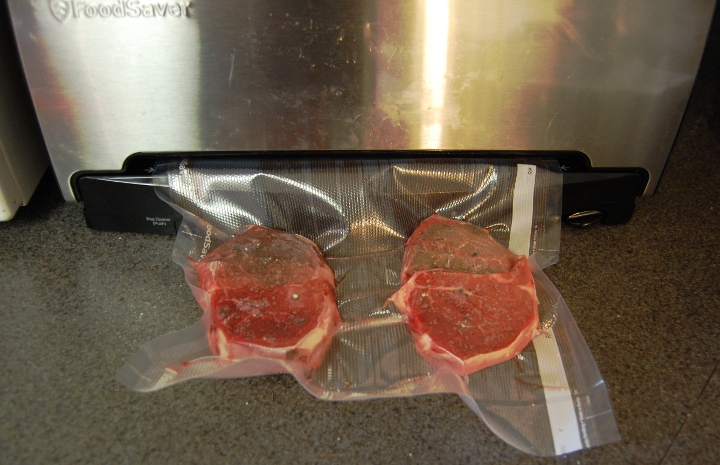
First, we put salt and pepper on each side of the steaks, just like you normally would. Then we put the steaks beside each other–but not touching–in a vacuum sealer bag and sealed them up.
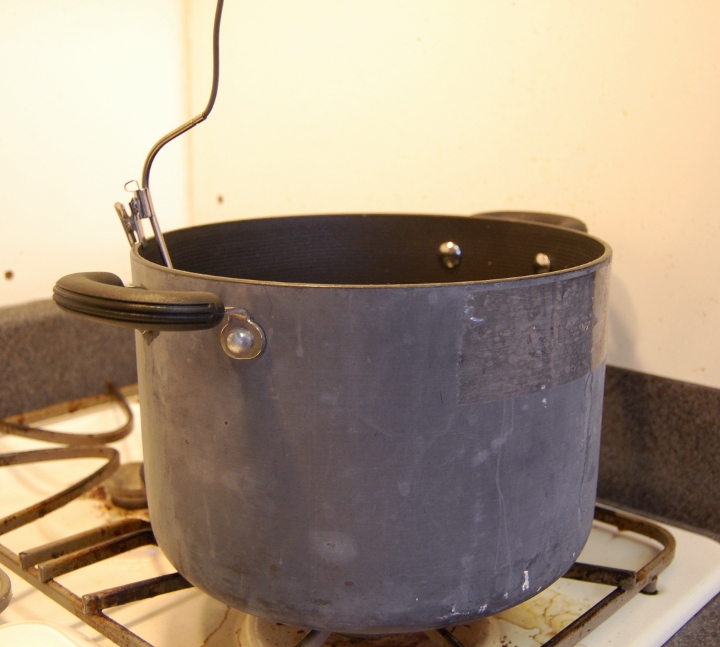
Next, we set up our “high-tech” sous vide water oven. We filled a pot with warm water. Then we hooked the digital thermometer to the side of the pot so that the temperature gauge was sitting in the water but not touching the pan. We did this by extending it with a clip that comes with the thermometer. You can also use a black metal paper clip.
We put the stovetop on medium low and set the temperature on the thermometer at 135 degrees. Then we waited for the water to reach that temperature. It took about 10 minutes.
When the temperature had reached 135 degrees, we put the vacuum-sealed steaks in the water.
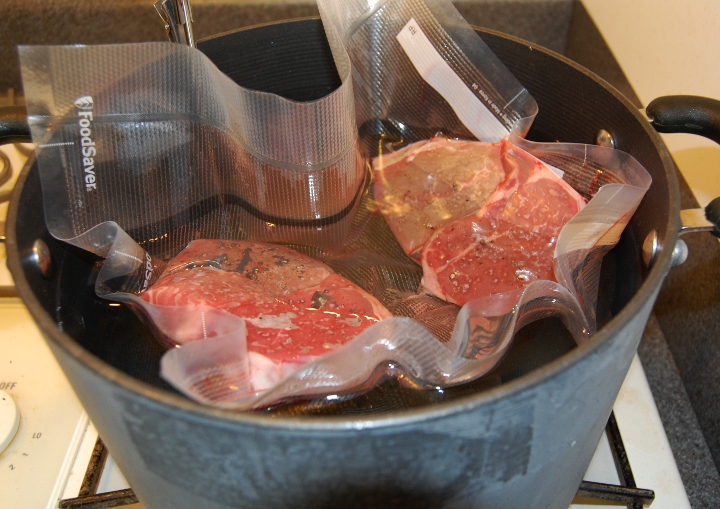
Of course, they floated. That wasn’t good because the meat has to be immersed in the water and yet not touching the bottom of the pan (the bottom is hotter than 135 degrees). So, I took a vegetable steamer and put it on top of the pot. It pushed the steaks down so that they were immersed in the water. You can also use a pot lid flipped upside down.
Sous vide takes a long time. There’s no exact time table here because, as I said before, you can have the steaks in the water for hours and they will stay at your required temperature.
We waited an hour, which turned out to be fine.
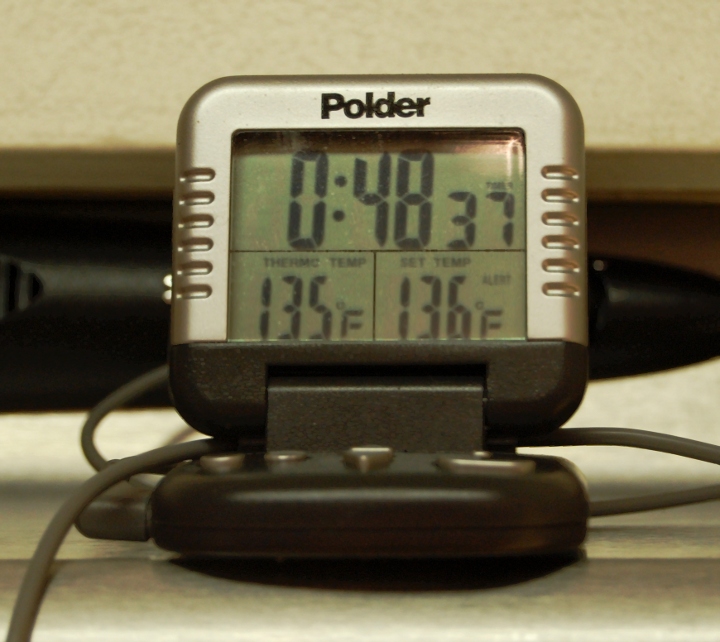
The only tricky part of DIY sous vide is monitoring the temperature. We wanted to keep the meat between 134-135 degrees. To do this, we set the stovetop on the lowest temperature and the alarm on the thermometer at 136 degrees. When the temperature got that high, the alarm went off and we added 1 cup cold water to the pot. This brought the temperature down to 134 degrees. It took the water 10 minutes to raise the two degrees again, the alarm went off at 136 degrees, and we added another cup of cold water. We did this every ten minutes and it kept the steaks right around 135 degrees.
After an hour, we took out the steaks. They looked exactly like boiled meat. It was time to sear them to get a good crust.
Why sear at the end of the cooking process and not the beginning? If you seared the steak at the beginning, the crust would get soft and weird in the vacuum-sealed bag. With sous vide, you cook the meat from the inside out.
To sear, we put approximately three tablespoons of oil in the frying pan, heated it up, and dropped in the steaks. We cooked each side for about 30 seconds to 1 minute, or until there was a nice brown crust. The end results?
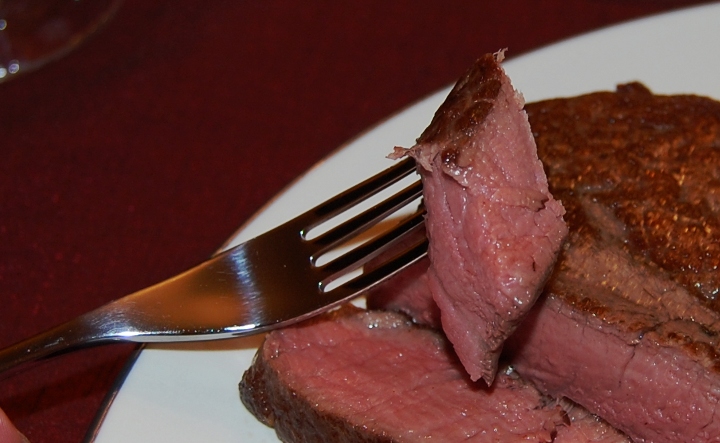
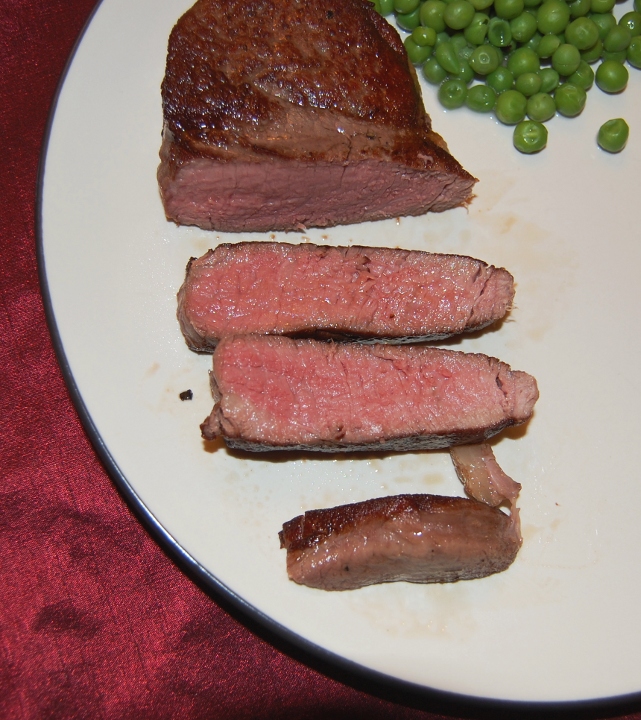
This was one of the tenderest steaks I have ever eaten. It was perfect. I would absolutely do this again, maybe even this week with another easy-to-overcook meat: pork chops.
So in summary: Vacuum seal, get the water to the temperature you want the meat to be at, stick the meat in, monitor the temperature, and sear. The end result? Perfectly cooked meat.
ETA: There is some concern in the comments about this giving you botulism. As I said in the comments, I do not think this is an issue for the following three reasons:
1. Botulism spores take at least 8 hours to germinate into the bacteria that kills you. For this to happen, you would have to cook the meat sous vide and then leave it sitting in the bag in lukewarm conditions for at least a half a day. Since you are going to take the meat right out of the bag and eat it, you don’t need to worry about it.
2. Botulism cannot penetrate a dense muscle like a steak or pork chop. As such, even if there WERE bacteria on your meat, it would be on the surface of the meat and so pan searing it would kill it.
3. If you are still concerned, cook the meat to 145 degrees. That is the magic number that kills all bacteria and will ensure that there is nothing in the bag that can hurt you. Of course, it won’t taste as good, but that’s the price of peace of mind, I guess.
If you are still concerned, please don’t use this method.

I so need to try this.
You do. I recommend it.
How about a crockpot?
Controlled temperature… would that work too?
I am going to try this very soon. I have two filets and they will be taking a nice long, warm bath. Oddly enough I have the same Polder thermometer and the same Circulon pot with that damn sticker mark that can never be removed. Thanks for the post.
Isn’t there a botulism risk in this? Or am I missing something?
*DANGER**DANGER**DANGER**DANGER**DANGER**DANGER*
There is a huge botulism risk in this – be very careful. American restaurants and food processors have not implemented this method because of the fear of accurate temperature control in the process operations.
“Clostridium botulinum bacteria can grow in food in the absence of oxygen and produce the deadly botulinum toxin, so sous-vide cooking must be performed under carefully controlled conditions to avoid botulism poisoning.[5] To help with food safety and taste, relatively expensive water-bath machines (thermal immersion circulators) are used to circulate precisely heated water. Differences of even one degree can affect the finished product.”
http://en.wikipedia.org/wiki/Sous-vide
What about using a high tempture device like a crock pot or frier combinded with a temp control device like the Johnson A419 Digital Temperature Controller set to shut the device off at 135 degrees and turn back on at 134 degrees?
I’ve been doing something similar for years now. I seal up the steaks and put them in 100 degree water for an hour. Then I sear them on a very hot grill for 90 seconds a side then rest them under a foil tent. They come out a perfect medium rare from surface to surface. -RP
Clostridium botulinum spores would only exist on the outside of the beef unless the outside of the steak has been penetrated. So as far as botulism goes all you need to do is sear the outside of the steak to be safe.
Thinkerer: Whoa. Calm down. Normally I would delete such a hysterical comment, but since this issue is bound to come up, let’s address it. First of all, you are absolutely wrong that American restaurants “have not implemented” this method. It is widely used across the U.S. Let’s not spread false information.
Cooking food on a low temperature does not cause botulism–otherwise we could not use crockpots. The risk here is the vacuum sealing. The airless atmosphere of the vacuum pack encourages the growth of botulism. BUT–and this is key–that is over a long period of time, as in *days.* It takes 8 hours for a botulism spore to form. In restaurants, the meat might be cooked and then stored in the vacuum-sealed bags for a week in the fridge. If they don’t cool the meat fast enough after cooking, that can cause botulism spores to germinate and reproduce. But in your kitchen, you are not going to have the meat sitting around for days in a plastic bag, right? You are going to eat it right away. As such, the risk for botulism is nil.
However, to be extra exxxtra safe, here are a few tips:
* Make sure everything is clean and sterilized.
* Refrigerate the meat before cooking.
* Eat the meat right after cooking.
* Do not store the meat in the vacuum-sealed bag after it is cooked.
* If you are still worried, you can cook the meat to 145 degrees, which is the magic number that kills bacteria.
If, after all that, the thought of botulism still leaves you shaking in a corner, then by all means, please avoid this method.
ETA: Thomas is also right that it is hard for botulism to penetrate a solid muscle. Pan searing should kill anything on the surface of the meat.
I have been toying with the idea of this kind of setup for a while, and I’m glad someone else did it AND documented it!! Beautiful!
I was wondering how the addition of salt to the water would have affected the ability to maintain the temperature?
–Chef Shaya
Chef Shaya, thank you! I don’t know about salt, but that is a great question. My guess is it wouldn’t make much difference unless you added a lot of salt.
Jennalynn, the problem with the crockpot is that it would be difficult to get the exact temperature. If there were a way to rig the crockpot to be more exact, then it would probably work.
Tip: Trader joes sells vacuum sealed steaks and filet mignon tenderloins for about 6-10 bucks a pound. I just got a filet and will be trying this out after I get a temperature gauge.
Do you mean i can cook the TJ’s steaks in their original vacuum bags? i don’t have those fancy vacuum things yet.
The key to sous vide is the constant temperature of the bath. I first started with the same manual thermometer control system and it works fine for short term cooking. But when I started to cook long term recipes like 36-48 hour ribs, a PID controller (sousvidemagic.com) saves the day. Depending on what I am cooking, I use both crockpot and rice cooker.
Thanks
I’ve done a fair amount of SV at home (and had it in restaurants), and it is phenomenal when done right. Flavor suffuses the meat, and it transforms the texture.
It is good to sear before and/or after SV. This helps with contamination issues and flavor. I recently did a deconstructed rack of lamb tagine with 20-hr SV, and it was amazingly good. One photo: http://www.flickr.com/photos/smashz/3272955541/in/set-72157613681972028/ (others in my photostream, including beef cheeks)
A crockpot without a control will not work. It fluctuates too much. Also, even on low, the heat is too high, coagulating the proteins.
What a brilliant idea! There shouldn’t be anything difficult about sous vide but just breaking out all the doo-dads and trying it. Thanks for the boost of confidence!
Will the plastic melt? I have some health concerns about subjecting plastic to high heat! Also, do you think it’ll work with a normal ziplock bag? Assuming I pack the meat individually and try my best to press out the air?
You can use a Ziploc bag for low heat sous vide, but not for confit or veggies (>~170°F). It is just fine for animal proteins (~126°F-~146°F) and fish & seafood (~113°F).
It is easy to get the air out of a bag. Just put the stuff in, then submerge the bag in water until just the opening is out. The water pressure will press all the air out.
Where did you get that Thermometer clip? Every clip I have for holding thermometers SUCKS but that one looks like it would actually function. Did it come with the Polder product?
Jimmy, it came with the thermometer. It works great. Although, I have had equal luck with a black paper clip.
DANGER*DANGER*DANGER*
idiots exist and know where the caps lock key is. those with reading comprehension and common sense can enjoy a nice steak.
The military has used sous vide cooking for years; there are very few botulism cases..
you do the math.
Thinkerer seems to have gone on a rampage of sous vide smearing on several blogs. I’ve read quite a few in preparation to try out sous vide this weekend, and almost all of them have the same fanatical warning.
A comment about the salt affecting the water- salt will not help with keeping the water at a constant temperature. While it is true that salt affects the properties of water, these only extend as far as the temperatures in which water freezes or boils. Adding salt to water will make it freeze at a lower temperature and boil at a higher temperature, but it cannot actually change the physical temperature of the water.
Source: I’m a science major
According to this data increasing the salinity (Or probably most dissolvable solids) decreases the thermal conductance. Since you want all heat spread around quickly it is probably best to use distilled water, however it is a negligible gain. Just use tapwater in other words :D.
Oops left out the source. Here you go! Found via the wikipedia page for seawater.
http://twt.mpei.ac.ru/tthb/2/Tab-5-5-13-2-Ther-Cond-Seawater.html
One trick for stove top sous-vide is to mess a little bit with the overall thermal efficiency from the burner to the pot.
For example my dutch oven will maintain ~150f on my stoves lowest setting. If I fill a stock pot with water, put a baking rack on top of that, and put the dutch oven on top of that, the whole system looses enough heat to hold ~135 with very little maintenance (adding cool water). The baking rack insures that there is enough of a air gap around the bottom of the dutch oven to allow enough of the heat from the water below to escape around the sides.
That said I’m still getting a PID system now that I have tried it a couple of times.