
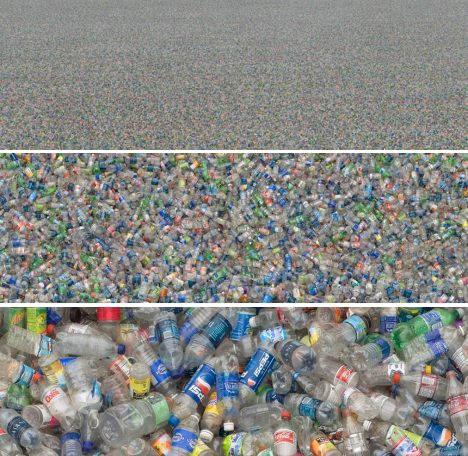
(Photo depicting 2 million plastic bottles – the number of bottles used in the US every 5 minutes.)
Since I started composting, I have become aware of how much plastic I use. Once I started separating my organic waste, and recycling all my paper, it became clear to me that every week I was basically throwing out a (plastic) garbage bag of mostly … plastic. Sure, there are other things in there, but the majority of actual garbage my husband and I produce is plastic. You know, things like bags, bottles, wrappings from meat or cheese, packaging, and so on.
So I was interested in ReadyMade’s Week Without Plastic experiment. Katherine Sharpe decided to try to not use plastic for a week, and quickly encountered how difficult that is.
Here are some sample questions she asked during the experiment:
• Is the lid of my ‘I Am Not A Paper Cup’ made of silicone? Is silicone plastic? Are there any 100% plastic-free on-the-go coffee container options?
• Are rubber bands made of plastic?
• Are mason jars microwaveable? (The glass parts, not the metal lids.)
• What did meat used to be packaged in for sales and serving—before, say, World War II? When did plastic come in for meat? What is meat sold and stored in other countries?
• Is there any place in this city where I can buy some raw meat without its being packed in plastic?
• Are the little stickers on fruit made of plastic?
• How can I store vegetables and fruits in my refrigerator and not use plastic?
• Is there any viable alternative to plastic garbage-can liners for my kitchen?
• I buy a lot of foods like rice and nuts and beans that come in plastic bags. Are there ways to get and store these in other types of packaging?
And also:
• Why can I recycle #1 and #2 plastic containers, PET and HDPE, but not other kinds of plastics, even when they have chasing-arrow signs on them? Is there any place that recycles plastics #3 through #10?
• Does all the plastic that I put out at curbside actually get recycled? How “good” is plastic recycling, anyway?
All good questions, although someone needs to introduce her to butcher paper. Still, plastic is an environmental problem. For one thing, it takes a lot of energy to produce. For another, as mentioned above, only two types of plastics are recyclable (as far as I know)–#1 and #2, the tiny numbers you can find on the bottom of the container. Numbers 3-10 are not recyclable, which automatically makes them waste.
And finally, there is a garbage patch the size of Texas in the Pacific Ocean–the marine litter tends to accumulate in one place. Most of that garbage is plastic. And that plastic will never disappear. It just breaks down into smaller and smaller pieces, which means fish are eating it along with plankton, which in turn means that plastic is entering the food chain.
Also, plastic is increasingly strangling and killing sea life that gets tangled in it.
Depressing, right? Ugh. Anyway, the point is, I have been cutting back on plastic. I’m not extreme about it. After all, plastic is not a bad thing in and of itself–it is just overused. I don’t know how I would store food without it. However, I have noticed that over time, my consumption of plastic has lessened. It wasn’t hard at all.
Here are some changes I made:
- I pick paper over plastic bags.
- I re-use plastic bags at least once (saves money).
- I have a re-usable drinking bottle for water (also saves money because I am drinking free tap water instead of paying for water).
- I re-use plastic tubs (saves money because I buy less Tupperware).
- I am slowly replacing all my plastic cooking implements with wooden or metal ones.
- When I make a food purchase, along with price and where the food came from, I now consider the packaging it comes in too.
Plastic is mind bogglingly commonplace. I mean, I am typing on a plastic keyboard right now. The pen sitting on the keyboard is also plastic. My phone is plastic. The heater beside me is plastic. So is my treadmill. And my fax machine. And my mouse. And the bottle of lotion on my desk… It really is amazing how much plastic is in our lives. It’s practically impossible to avoid. But I am still going to try to resist it where I can–at least when it comes to the easily disposable kind.
I so agree with you!
I started recycling years ago, and I always try to reduce consuming, reusing, remodeling, etc.
It’s such a waste of resources, energy and health for the planet!
Thanks! It’s not really so hard, either.
I need the answer to this one:
• Is there any viable alternative to plastic garbage-can liners for my kitchen?
I reuse the plastic grocery bags, but now there is the big push to get rid of them. I have never bought a box of garbage bag in my life. I already have an extensive composting system and I try not to buy food with a lot packaging. I go to a butcher who wraps the meat in paper and I mostly get my breads at a bakery that also uses paper, but I still end up with a full (small) plastic bag of garbage per. Any suggestions?
that should read as: per week
Dina, that’s a good question. It sounds like you are very responsible with your waste! Before plastic, I think people had to physically carry their garbage can out and dump it into the larger garbage. You can also use paper bags, which decompose better than plastic. However, it’s all pretty gross, which is probably why the plastic caught on in the first place.
Paper bags do decompose faster, but they also take more energy to produce. Have you ever driven by a paper mill?- lots of chemicals used and toxic smoke. Easy soloution = bring your own bag! =) Keep a few in your car, make it a habit. I’ve done it for over 20 years, my canvas bags last at least 10 years with lots of washing. =)
There are glass refridgerator boxes, you can see the food easier than in plastic, our grandmothers used them. Also, there’s no dangerous (cancer causing) off-gassing from storing food in glass instead of plastic.
And yes, do carry your kitchen trash can out to dump in the larger can. You have to walk out there and back anyway, it really isn’t any more effort to carry an empty can back with you. Plastic bags don’t degrade, every single one you use adds to the problem.
A whale beached itself in Washington State recently, just north of where I live. It had more than 20 plastic bags in it’s stomach. The Pacific Garbage Patch isn’t something far away that is somebody else’s problem, it’s our mess, and every choice we make matters.
http://www.youtube.com/watch?v=Fgao-jHF42k
Here’s a great video for anybody who needs a little inspriation to use less. =)